
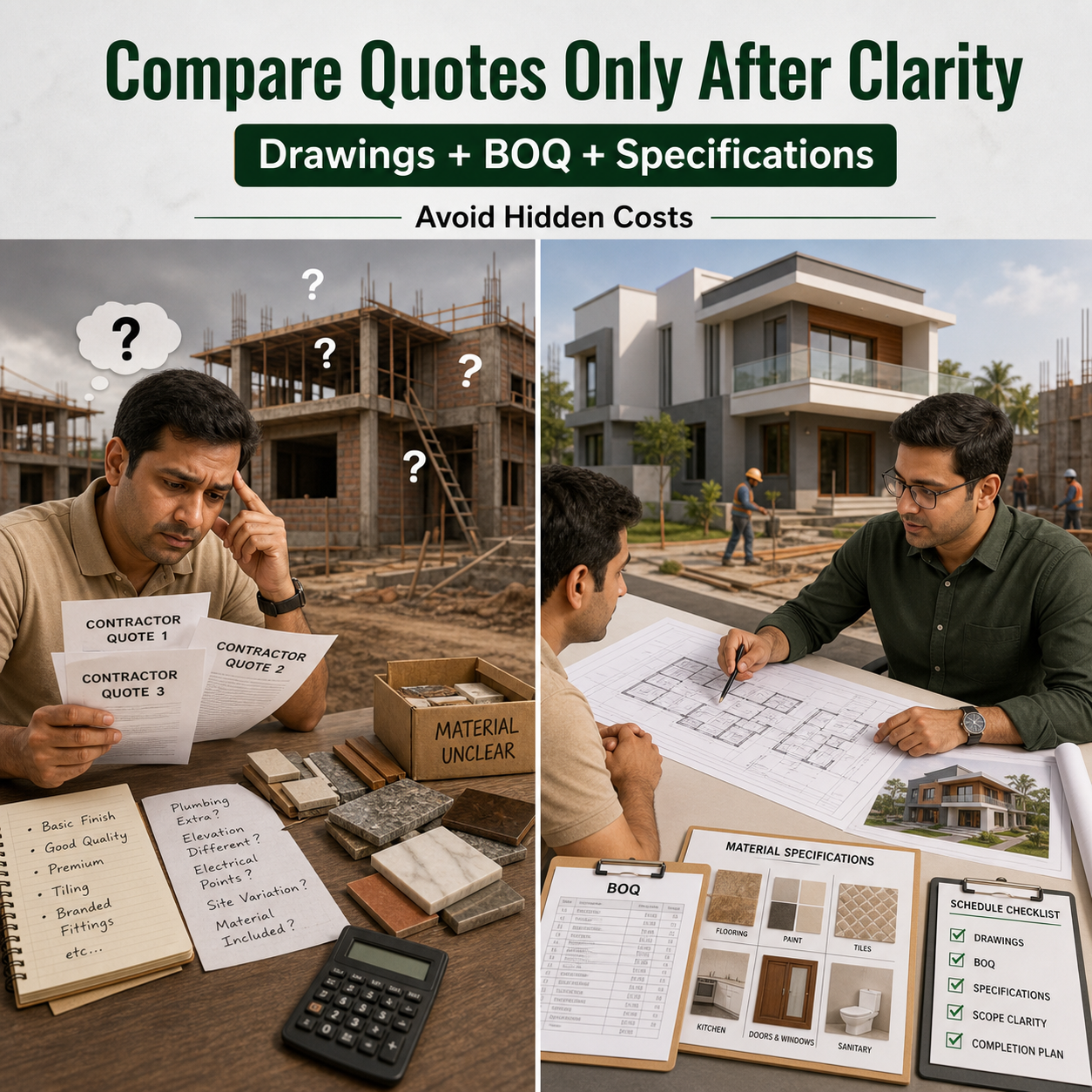
Many clients ask for construction or interior quotations very early. That is understandable because budget matters. But comparing contractor quotes before drawings, BOQ, specifications and scope clarity are ready can create confusion instead of saving money.
Two contractors may give very different rates, but they may not be quoting for the same work. One may include better materials, another may exclude plumbing or electrical changes, one may assume basic finishes, and another may include branded fittings. On paper, one quote looks cheaper. During execution, the missing items slowly appear.
A quote is useful only when the scope is clear
A construction quote should be based on a clear scope. The contractor should know what is being built, what drawings are approved, what materials are expected, which services are included and what finishing level is required.
Without this clarity, the quote becomes a rough guess. Later, when the client asks for a better tile, a different elevation finish, more electrical points, proper waterproofing or extra plumbing work, the cost changes. This is where disputes usually begin.
- Drawings explain what has to be built.
- BOQ explains the measurable work items.
- Specifications explain material quality.
- Scope notes explain what is included and excluded.
- A schedule explains the expected sequence and timeline.
When these are missing, the client is not comparing quotations properly. They are comparing assumptions.
Cheap quotes often hide missing details
A low starting quote may feel attractive, but it can become costly if important items are not clearly mentioned. Common missing or unclear items include excavation depth, steel and concrete specification, waterproofing, electrical points, plumbing fixtures, door and window quality, tile brand, painting system, false ceiling, hardware and site cleaning.
These items may look small individually, but together they can change the project cost by a large margin. They can also delay the work because decisions are being made at site instead of before execution.
BOQ brings discipline to cost discussion
A BOQ, or Bill of Quantities, gives structure to the quotation. It breaks the project into measurable items so contractors can quote on the same basis. This makes comparison more practical and reduces hidden differences.
A good BOQ does not only mention quantities. It should also connect with drawings and specifications. If the drawing shows a wall, the BOQ should account for it. If the design requires a certain finish, the specification should mention the expected quality.
With this approach, the client can ask better questions: Why is this item higher? Is the material different? Is labour included? Is transport included? Are taxes included? What is excluded?
Specifications protect quality
Material specifications are important because words like standard, premium, good quality or branded can mean different things to different people. Without proper specification, the client and contractor may both be correct in their own understanding, but still disagree at site.
Specifications should clarify practical items such as tile size and type, sanitary fixtures, paint system, waterproofing method, electrical wire brand or grade, switch type, door hardware, window system, kitchen material and finishing details.
This does not mean every client must choose every brand on day one. But the expected level should be clear enough for a fair quote.
Consultants reduce confusion before execution
A design and supervision consultant helps the client prepare the project before asking for final execution rates. This includes space planning, working drawings, service coordination, BOQ direction, material clarity and supervision checkpoints.
This process helps contractors quote responsibly and helps the client understand what they are paying for. It also reduces unnecessary arguments during execution because the drawings and scope become the common reference.
What to finalise before comparing quotes
Before comparing contractor quotations, the client should ideally have the following ready:
- Approved floor plan and space planning.
- Structural or execution drawings where applicable.
- Electrical and plumbing requirements.
- Basic material and finish specifications.
- BOQ or item-wise scope sheet.
- Clear inclusion and exclusion list.
- Timeline and payment milestone understanding.
A quotation should not be selected only because the first number is low. It should be checked for completeness, clarity and realistic execution.
Good planning before quotation does not make the project complicated. It makes the decision cleaner. When drawings, BOQ and specifications are ready, the client can compare contractors with confidence and avoid many hidden costs later.