
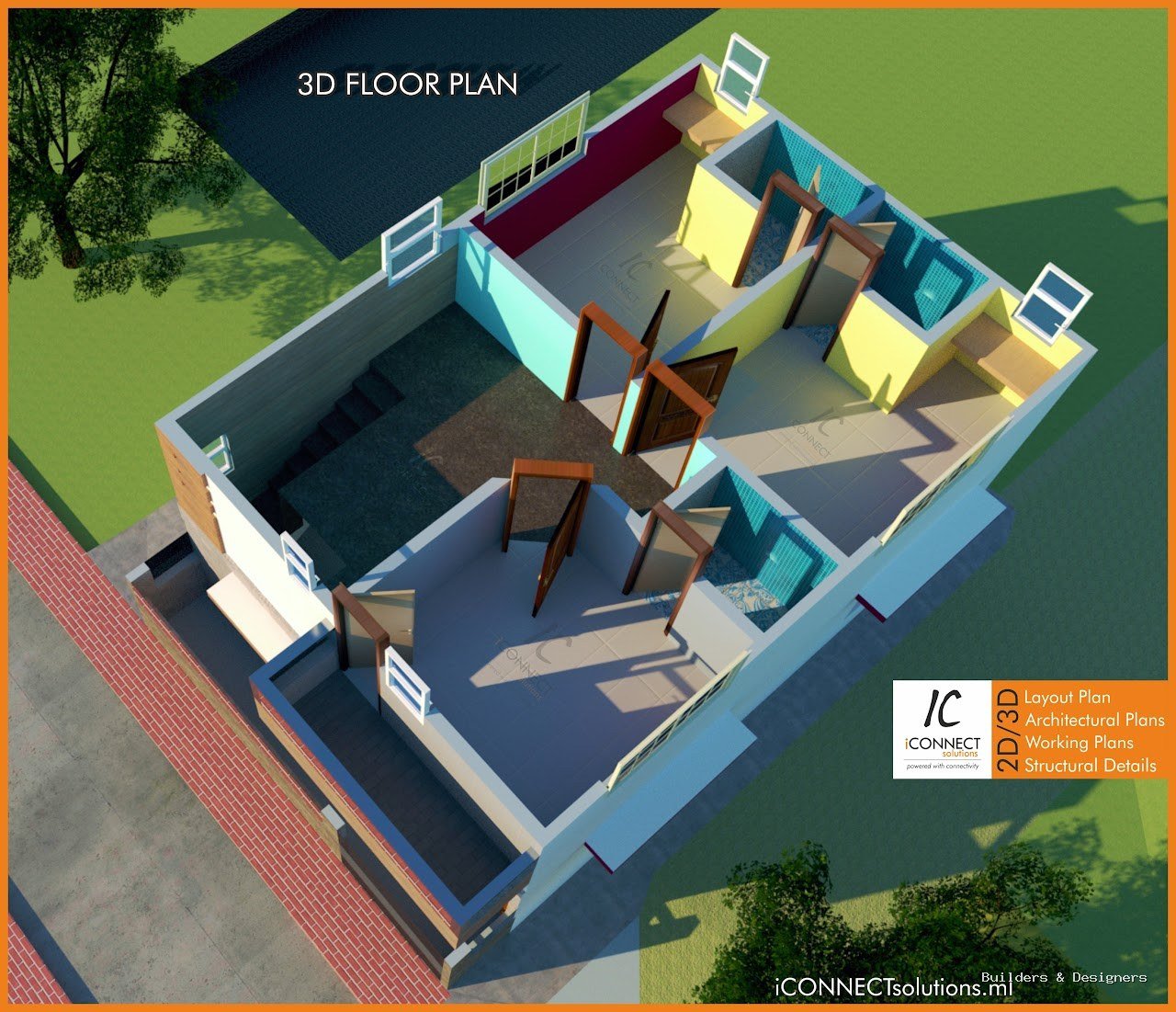
A 2D floor plan is essential for dimensions, but some circulation issues become easier to discuss when the walls and doors are seen in three dimensions. An open-top 3D plan can show how people enter rooms, where doors may conflict and how the passage connects different spaces.
This residential 3D plan for a site in Tumkur shows several rooms organised around a central circulation area, with multiple doors and clearly visible wet zones. The view is useful for reviewing movement before the design moves into detailed working drawings.
Door swings affect usable space
Every door needs space to open without striking furniture, another shutter or a person using the passage. In compact areas, several doors opening near one another can create congestion. The 3D view makes their direction and relationship easier to notice.
Central circulation should remain readable
A central connecting area can reduce long corridors, but it should not become a collection of competing doorways. The route from the entrance or stair to each room should feel direct, and frequently used doors should not block the path when left open.
Wet areas need privacy and ventilation
The blue-tiled zones indicate toilets or bathrooms. Their approach, door orientation and openings should be checked for privacy. Detailed planning must also coordinate plumbing walls, ventilation, floor slopes and waterproofing.
Windows help explain room usability
The 3D view shows openings on external walls, helping the client understand which rooms receive light and ventilation. Window size and sill height still need to be confirmed in the architectural drawings, but their position is easier to visualise here.
- Check every door swing against the adjacent passage and room.
- Avoid door-to-door clashes near common circulation.
- Keep bathroom entrances reasonably private.
- Confirm that each enclosed room has suitable openings.
- Use the 3D view for discussion and the 2D drawings for dimensions.
A 3D floor plan should not replace technical drawings. Its value is that it makes spatial relationships easier to see, so questions about movement, doors and room connections can be resolved earlier.