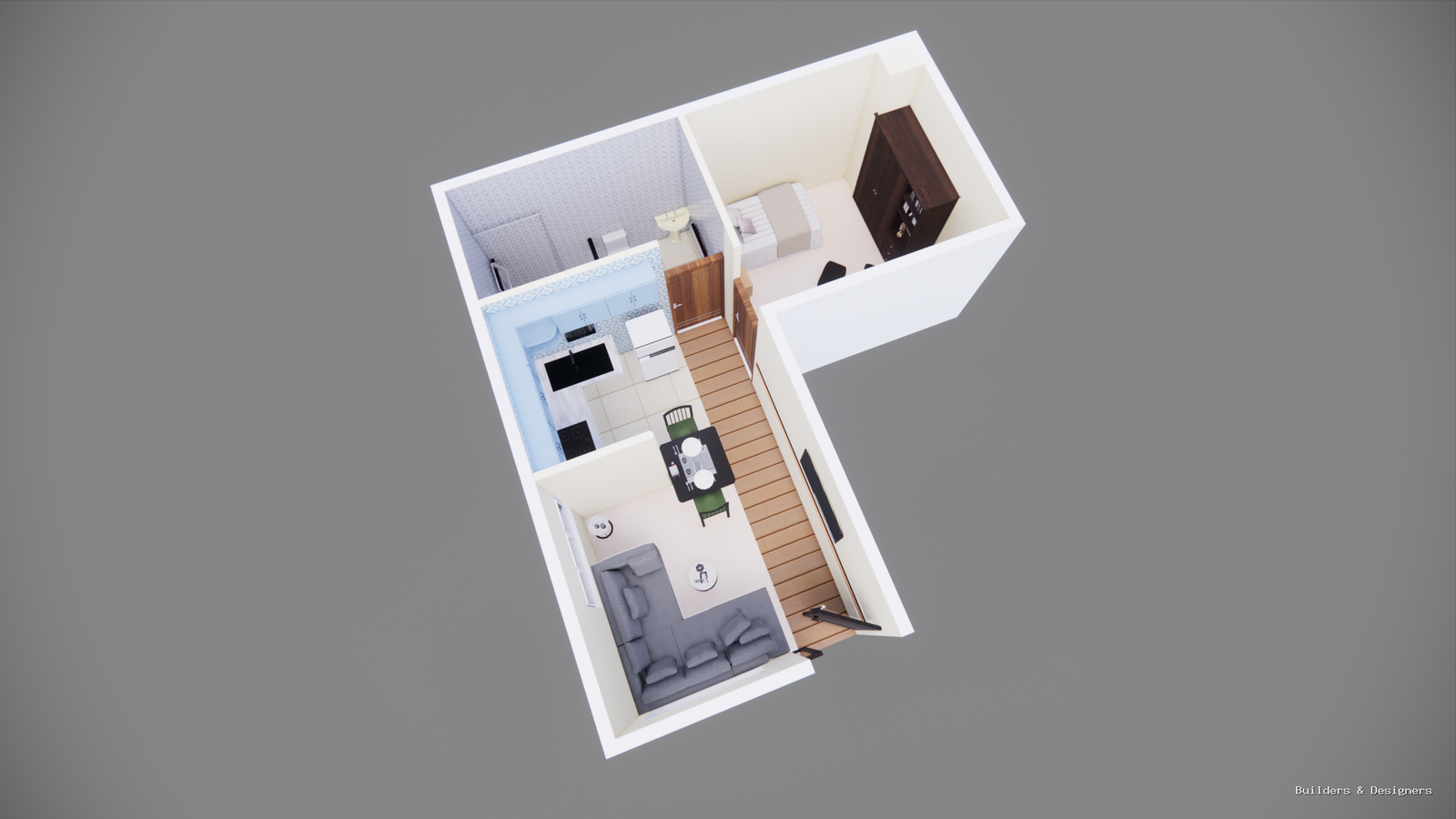
A floor plan gives dimensions and wall positions, but many homeowners understand the space more easily when furniture and fixtures are shown. A furnished 3D plan can reveal how the living area, dining table, kitchen, bedroom storage and bathroom fittings relate to the actual movement paths.
This compact residential layout near NIMHANS, Bengaluru, shows a living area, dining table, kitchen, bedroom, wardrobe and bathroom from several angles. The closer view of the bathroom and kitchen also helps explain wet-area relationships.
Furniture shows the usable room, not only its boundary
A bedroom may fit within the walls but still feel tight after adding a bed, wardrobe and chair. Similarly, a sofa and dining table need walking space around them. The 3D view makes these clearances easier to discuss before detailed interior work begins.
Shared spaces need an unobstructed path
The living, dining and entrance route are connected in a compact area. Furniture should support that route instead of narrowing it. Door swings, dining chairs and the edge of the sofa are important because they affect everyday movement.
Kitchen storage should follow the work zone
The kitchen view shows counters, overhead storage and appliances in a small footprint. During detailed planning, counter depth, refrigerator clearance, shutter opening and ventilation need checking together. A visually complete kitchen is useful only when it also remains practical to use.
Wet areas benefit from fixture-level review
The bathroom close-up shows the shower zone, toilet, basin, window and partitions. This helps discuss door movement, fixture clearance and how wet and dry portions may be separated. Plumbing slopes and waterproofing still require technical drawings beyond the 3D presentation.
- Review furniture sizes rather than generic symbols alone.
- Keep a clear path from entrance to bedroom and bathroom.
- Check wardrobe and cabinet shutter openings.
- Review kitchen appliance and counter clearances.
- Coordinate bathroom fixtures with plumbing and ventilation.
A furnished 3D plan is most useful as a discussion tool. It helps the client see the practical consequences of the layout while the design team uses detailed drawings for execution.