
A staircase may occupy a compact portion of a house plan, but structurally it connects several important elements. Flights, landings, floor slabs, supporting walls or beams and the surrounding columns must be coordinated so that the detail can be understood and executed at site.
The structural drawing set for this G+3 residence at Hegde Nagar, Bengaluru, includes a column and wall schedule together with detailed staircase drawings. Reading these sheets together helps explain why a staircase should not be treated as an isolated architectural feature.
The column schedule keeps levels consistent
The column and wall schedule identifies different member types and shows their reinforcement arrangement across building levels. In a multi-storey residence, this helps the site team distinguish member sizes and reinforcement changes instead of assuming that every column remains identical from the foundation to the roof.
A clear schedule also supports checking at transitions between floors. When a staircase opening sits near columns or structural walls, those member positions should match the architectural plan and beam layout before shuttering and reinforcement work proceeds.
Staircase geometry affects the structural detail
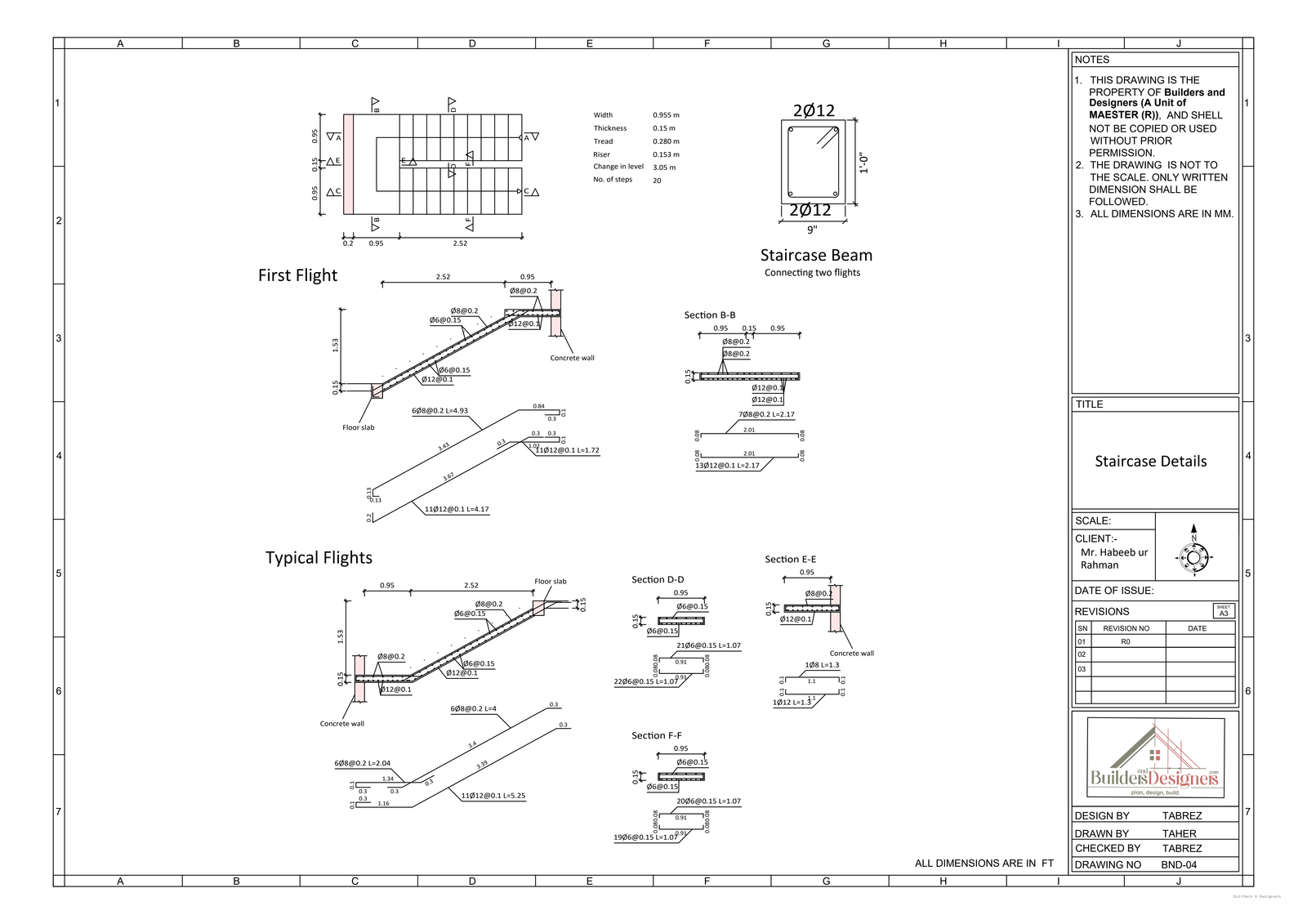
The staircase sheet visibly records flight width, tread, riser, number of steps and change in level. These dimensions define the actual geometry that the reinforcement detail must follow. If floor levels or the architectural stair arrangement change, the structural staircase detail may also need revision.
The drawing shows separate flight views and sections, along with reinforcement information at the flight, landing and supporting edge. This gives the site team more than a simple plan outline; it explains how the stair behaves through its depth and at its connections.
Connections need special attention
The points where a flight meets a landing, slab, concrete wall or staircase beam are important during execution. Reinforcement length, anchorage and continuity should follow the issued structural drawing. Openings and nearby members also need to remain coordinated so that later changes do not weaken or obstruct the intended arrangement.
Checks before staircase concreting
- Confirm stair width, tread, riser, number of steps and finished floor levels.
- Match the opening and landing positions with the latest architectural drawing.
- Verify the supporting wall, beam and column locations.
- Check reinforcement direction, spacing and anchorage against the structural sheet.
- Coordinate electrical conduits, railing inserts and other embedded items before concreting.
Good structural detailing reduces questions during shuttering and steel fixing. More importantly, coordinated drawings help the architectural stair, structural support and site execution describe the same staircase.